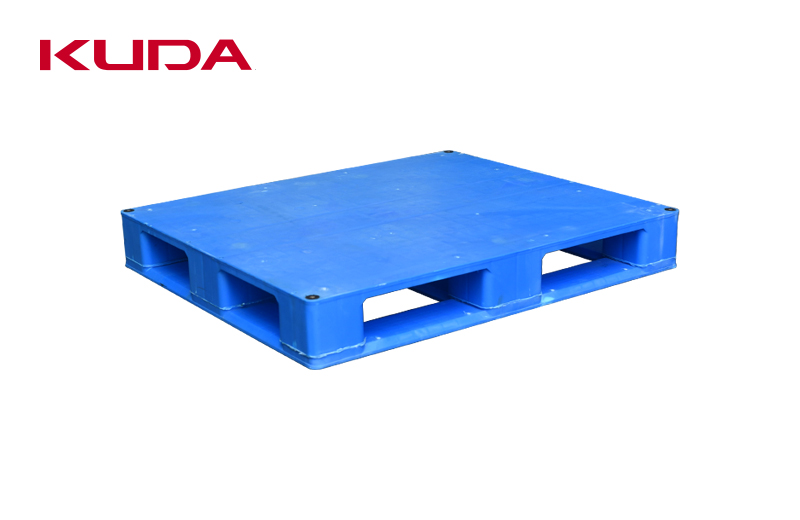
In modern logistics and warehousing systems, plastic pallets, as the core tool for cargo carrying and turnover, are gradually replacing traditional wooden and steel pallets with many advantages and becoming the mainstream choice in the industry. Plastic pallets, also known as plastic trays or floor boards, are mainly made of low-pressure high-density polyethylene (HDPE) and polypropylene (PP) as raw materials. They are molded in one go through injection molding, blow molding, and other processes. Some products also use welding technology to further strengthen the structure. Its structural types are diverse, including single-sided, double-sided, nine legged, T-shaped, Sichuan shaped, etc., which can be flexibly selected according to different usage scenarios and needs. For example, nine legged pallets are suitable for automated three-dimensional warehouses, while Sichuan shaped and T-shaped pallets perform well in shelf storage and heavy cargo carrying.
The performance advantage of plastic cardboard is the key to its standing out. In terms of corrosion resistance and moisture resistance, plastic cardboards perform far better than wooden and steel cardboards, and can be used for a long time in humid and acidic environments without damage; Its characteristics of no nails, no thorns, and no scars avoid the risk of scratches during the transportation of goods, and it also does not breed insects like wooden pallets, making it more hygienic and safe. In terms of load-bearing capacity, conventional plastic pallets can reach dynamic loads of 1000-1500kg and static loads of up to 6000kg. The shelf load capacity of reinforced products can exceed 800kg, which is sufficient to meet the turnover needs of the vast majority of industrial goods. In addition, the service life of plastic cardboard can reach 6-8 years, and it can be recycled and reused after damage, which is in line with the development concept of environmental protection and circular economy.
With the continuous advancement of technology, the functions and application scenarios of plastic card boards are also constantly expanding. To meet special needs, functional variants such as anti-static and cold chain specific have emerged in the market. Anti static card boards can meet the anti-static requirements of precision products such as electronic components by adding carbon powder modified materials; The cold chain special type adopts low-temperature resistant modified PP material, which can maintain structural stability in a low-temperature environment of -40 ℃. Plastic cardboard boxes, as an extension product of plastic cardboard, integrate trays with the box body and have the characteristics of folding and stacking. They can effectively reduce product loss and save storage space. They are widely used in industries such as textile printing and dyeing, food and beverage, chemical industry, etc. They can load goods of various materials such as solid, liquid, and powder.
In practical applications, the standardization and customization services of plastic card boards further enhance their adaptability. Domestic plastic cardboards are standardized at 1200L × 1000W, and support customization of size, color, load-bearing capacity, and other parameters according to enterprise needs. For example, thick and reinforced cardboards can be customized to carry heavy machinery equipment, and cargo classification management can be achieved through a color coding system. Even enterprise logos can be printed on cardboards for brand promotion. From the temporary storage of goods on the factory production line, to the classified storage and organization in the warehouse, to the fixation and turnover of goods on transportation vehicles, plastic pallets run through the entire logistics process, providing strong support for enterprises to improve transportation efficiency, reduce logistics costs, and achieve sustainable development. The above article provides an overview of the basic definition, performance advantages, functional expansion, and application adaptation of plastic pallets, systematically demonstrating the important value and diverse characteristics of plastic pallets in the modern logistics field.


 2026-03-09