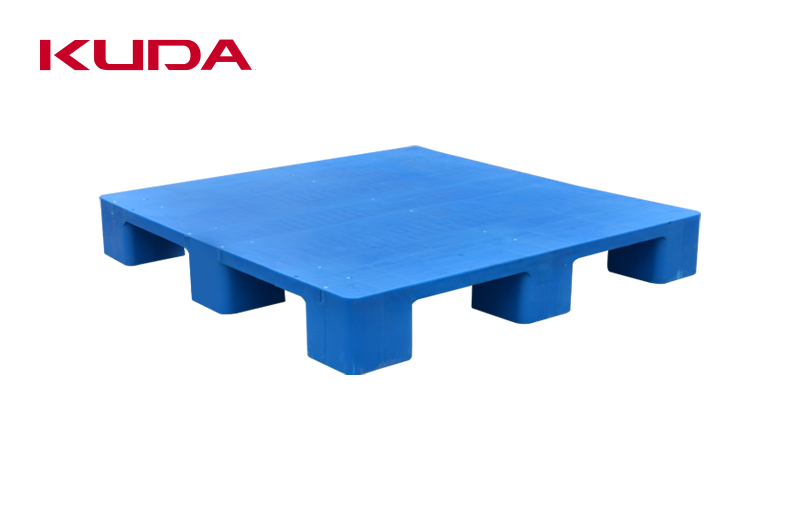
In the precise collaboration of warehousing and logistics, nine legged plastic pallets, with their unique nine point support structure, have become the core carrier for the turnover of lightweight goods. The evenly distributed support feet at the bottom achieve dynamic load-bearing balance through the principle of mechanical dispersion, effectively avoiding the risk of cargo tilting and significantly improving impact resistance. This design is not only suitable for automated equipment such as forklifts and AGV robots, but also reduces the burden of manual operation with the advantage of lightweight, injecting new energy into sorting efficiency. Its surface is designed with anti slip grids or flat plates, which have both moisture-proof and anti mold properties, meeting the hygiene standards of industries such as food and medicine, making it an ideal choice for cold chain logistics and e-commerce sorting centers.
The material advantage of the nine legged plastic tray is reflected in the injection molding process of high-density polyethylene (HDPE) or polypropylene (PP), which endows it with low temperature resistance, acid and alkali resistance, non-toxic and odorless characteristics, and is suitable for harsh environments ranging from -30 ℃ to 50 ℃. In the food industry, a flour mill achieves safe turnover of bagged goods through nine legged pallets, with a load-bearing capacity of 0.8 tons for dynamic loading and 2 tons for static loading, ensuring efficient operation; In the textile field, its wear-resistant surface protects the quality of the fabric, and its performance is suitable for heavy-duty coil stacking with a dynamic load of 1 ton and a static load of 3 tons. In addition, the characteristics that comply with the ISPM15 international standard simplify the customs clearance process in export transportation and make it a reliable partner for cross-border logistics.
The recycling value of nine foot plastic pallets far exceeds that of traditional pallets, which can be reused more than 200 times and have a lifespan of 5-8 years, significantly reducing the turnover cost of enterprises. Its lightweight design reduces transportation energy consumption, and the stacking of empty pallets saves 80% of storage space. Combined with a four sided fork structure, it improves the adaptability of automation equipment and increases overall efficiency by 30%. After scrapping, materials can be recycled and reused, reducing wood consumption and carbon emissions, forming a closed-loop model of "production use recycling". This economic viability makes it the preferred low-cost turnover option for small and micro enterprises, while also assisting large enterprises in achieving green supply chain transformation.
According to the application scenario, nine foot plastic pallets can be divided into two categories: light and heavy. For light turnover, nine foot grid pallets are preferred (dynamic load of 0.5 tons, static load of 1.5 tons), suitable for e-commerce sorting centers and cold chain transportation; For high requirements, flat nine legged pallets are selected to meet long-distance transportation and repeated turnover scenarios. In terms of industry customization, food and medicine prioritize flat moisture-proof design, while textile and paper are suitable for grid type wear-resistant surfaces. Through structural innovation and material upgrades, the nine legged plastic pallet carries the "big mission" with a "small body", injecting lightweight, high-efficiency, and sustainable energy into modern logistics.


 2026-02-27