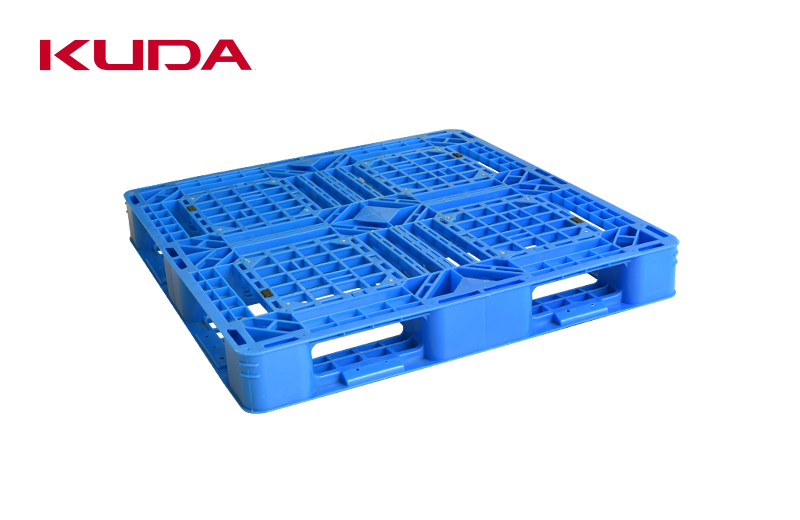
The core design concept of the grid tray is derived from the geometric shape of the Chinese character "Tian", which forms a regular grid framework with four intersecting horizontal and vertical ribs at the bottom, forming multiple uniformly distributed support units. Compared with traditional nine legged pallets, this continuous support network significantly improves structural redundancy - when a single support point is subjected to impact, adjacent grid cells can cooperate to share the load, effectively avoiding the risk of foot pier fracture. The friction coefficient between the surface grid pattern and the bottom of the cargo is about 40% higher than that of a flat pallet. When used in conjunction with anti slip pads, it can stably carry cylindrical barrel chemical raw materials and reduce the risk of slipping during transportation.
The unique bottom suspended design of the Tianzi structure provides moisture-proof protection for precision goods such as electronic components. In the clean room logistics of semiconductor factories, this design can effectively isolate ground moisture and prevent component failure due to moisture. At the same time, the meshing area between the grid surface and the forklift teeth is larger, and with the four-way fork design, the stability during mechanical handling is improved by about 30%, significantly reducing the probability of cargo overturning.
Performance advantage: Comprehensive upgrade from mechanical performance to application scenarios
The grid structure of the Tianzi tray has significant advantages in mechanical performance. The criss crossing ribs form a continuous support network, which evenly disperses the pressure of the goods through multiple nodes and enhances the bending resistance. A single static load-bearing capacity can reach several tons, and when stacking at high levels, the upper and lower layers are tightly interlocked, increasing stability by about 40%. In automated three-dimensional warehouses, this design can effectively adapt to strict shelf storage requirements and avoid damage to goods caused by pallet deformation.
The hollow structure of the grid shaped tray has excellent ventilation performance. In cold chain transportation, grid design can form natural airflow circulation, prevent tray brittleness caused by cold air accumulation, and avoid the deterioration of agricultural products due to stuffiness. The evenly distributed ventilation holes on the surface can also accelerate air circulation and prevent the packaging of cleaning and protective products from getting damp in daily necessities storage. For goods that are prone to moisture, this design can significantly extend the storage period and reduce the rate of damage.
Tianzi pallets are often made of recyclable materials such as high-density polyethylene (HDPE) or polypropylene (PP), which have the characteristics of heat resistance, cold resistance, impact resistance, and strong chemical stability. Its reusable characteristics are in line with the development trend of green logistics. Although the single purchase cost is slightly higher than that of ordinary pallets, the service life of more than 5 years and recyclability reduce the transportation cost of single boxes by about 18%. Against the backdrop of tightened environmental policies, this design is gradually replacing traditional wooden pallets and becoming the mainstream choice in the industrial pallet market.
Grid tray has become an indispensable component of modern logistics due to its scientific structural design, excellent performance, and wide range of application scenarios. From food cold chain to precision manufacturing, from warehousing and logistics to cross-border transportation, this design is supporting the efficient operation of the global supply chain with the posture of an "invisible cornerstone", and drawing a clear blueprint for the green development of logistics in the future.


 2026-02-26