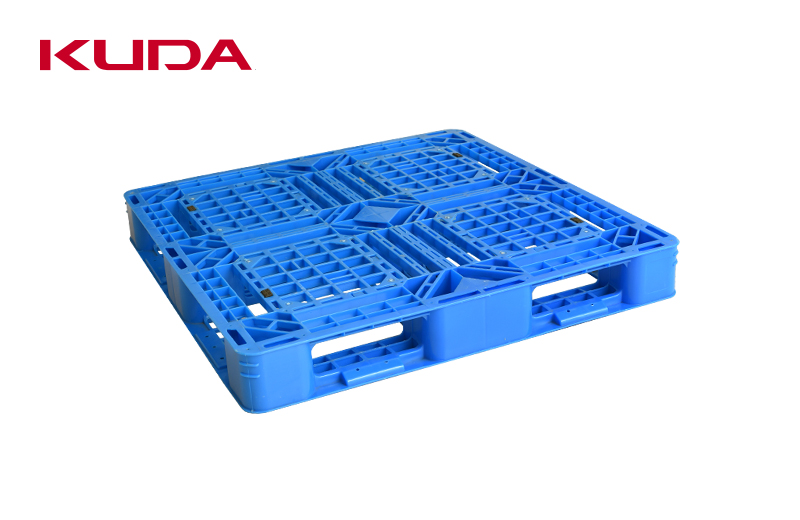
The Tian shaped tray is known for its unique bottom "Tian" - shaped grid structure, which is composed of criss crossing reinforcing ribs or dense foot piers, forming a uniform support network. This design achieves pressure dispersion through mechanical optimization, forming a multi-point support effect when gravity is transmitted to the shelf crossbeam, significantly improving load-bearing capacity and stability. Its material is usually high-density polyethylene (HDPE) or polypropylene (PP), which has the characteristics of low temperature resistance, corrosion resistance, and impact resistance, suitable for a wide temperature environment of -25 ℃ to 60 ℃, and easy to clean and disinfect, meeting the hygiene requirements of industries such as food and medicine. The four sided fork design further enhances operational flexibility and is compatible with various handling equipment such as forklifts and hydraulic trucks, greatly improving logistics efficiency.
Tianzi pallets perform excellently in shelf storage scenarios, with their grid like structure effectively dispersing the weight of goods and avoiding deformation or fracture caused by local stress concentration. They are particularly suitable for automated three-dimensional warehouses and long-term turnover needs. The dynamic load-bearing capacity can reach 1-2 tons, the static load-bearing capacity can reach 4-6 tons, and the shelf load is stable at 0.5-1 tons, ensuring safety during multi-layer stacking. In industries such as food, medicine, and chemical, its anti slip, shock resistant, and chemical corrosion resistant properties provide reliable protection for precision goods and reduce transportation losses. In addition, lightweight design reduces transportation costs, while the grid surface enhances drainage to prevent water accumulation from breeding bacteria, which meets the environmental and hygiene standards of modern logistics.
As a master of space utilization in logistics and warehousing, Tianzi pallets maximize vertical space utilization by neatly stacking goods, optimize warehouse layout, and are particularly suitable for high-frequency turnover scenarios such as e-commerce and retail. In production line logistics, it classifies and stores raw materials and finished products to improve material scheduling efficiency and reduce production interruptions caused by handling issues. For export trade, standardized sizes (such as 1100 × 1100mm) perfectly match containers, simplifying international transportation processes. Its durability (lifespan of 8-10 years) and low maintenance requirements further reduce long-term costs for enterprises, becoming a key tool for improving the overall efficiency of the supply chain.
The selection of Tianzi pallets should take into account the weight of the goods, storage environment, and handling equipment. Priority should be given to models with matching load-bearing capacity, and the placement surface should be flat and dry to ensure even stress distribution. With the popularization of automated warehousing, Tianzi pallets are becoming the core components of intelligent logistics systems due to their high-precision dimensions and RFID integration potential. The trend of customization is becoming increasingly prominent, such as designing imitation support structures for heavy goods to enhance impact resistance. As an environmentally friendly choice, its recyclable material meets the sustainable development goals, indicating its widespread application in green logistics in the future.


 2026-02-03