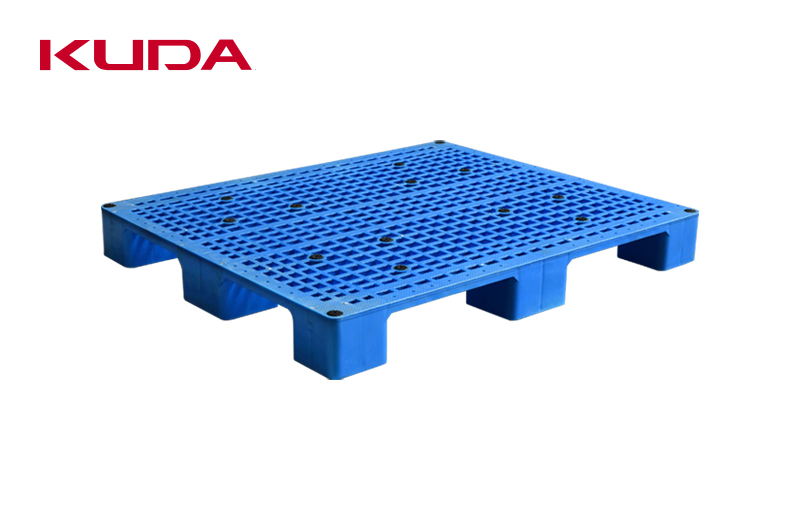
Forklift plastic pallets are made from high-density polyethylene (HDPE) or polypropylene (PP) through injection molding or blow molding processes, and have lightweight, high durability, and corrosion resistance characteristics. Its surface is smooth and nail free, which can effectively prevent scratching and damage during cargo handling. At the same time, its acid and alkali resistance, as well as low temperature resistance, make it suitable for diverse environments such as cold storage and chemical warehousing. Compared to traditional wooden pallets, plastic pallets have a significantly longer service life, up to 3-5 times that of wooden pallets, and eliminate maintenance costs such as fumigation and anti-corrosion. Lightweight design significantly reduces manual handling intensity, and when combined with forklift operations, it can flexibly achieve rapid turnover and stacking of goods.
The structural innovation of plastic pallets is the key to their efficient application. The four-way fork design breaks through the traditional two-sided fork restriction, allowing forklifts to be inserted into pallets from any direction, greatly improving operational flexibility in narrow passages, reducing forklift adjustment time and the risk of cargo damage. The bottom support structure (such as nine legged, Tian shaped, and Chuan shaped) enhances stability by dispersing forces. The nine legged pallet achieves uniform pressure distribution with nine support points, making it suitable for light load scenarios of manual forklifts; The Tian shaped structure enhances its bending resistance through mesh connections, meeting the requirements of heavy loads. The double-sided grid design further optimizes space utilization, facilitating three-dimensional storage and automated sorting of goods.
In the field of logistics and warehousing, plastic pallets seamlessly connect with shelves and forklifts through standardized sizes (such as 1100 × 1100mm, 1200 × 1000mm), becoming a standard configuration for e-commerce sorting centers and cold chain warehouses. The food and beverage industry relies on its easy to clean, non-toxic, and odorless characteristics to avoid cross contamination; In the chemical industry, its corrosion resistance is utilized to safely carry hazardous materials. In three-dimensional warehousing, the stackable design significantly improves the utilization of vertical space, and with the help of automated equipment, achieves efficient circulation of tens of thousands of packages per day. In addition, the fumigation free feature accelerates the export process of goods and helps enterprises with capital turnover.
The recyclability of plastic pallets is in line with the concept of green logistics. Damaged pallets can be reshaped into other products after processing, reducing resource waste. The advantage of full lifecycle cost is highlighted: although the initial procurement cost is high, it is significantly lower than the annual usage cost of wooden pallets, and the leasing model further optimizes the enterprise's expenditure structure. With the evolution of technology, intelligent tray integrated sensors enable cargo tracking, continuous upgrading of lightweight and durability, and promote the transformation of the supply chain towards high efficiency and low carbonization. In the future, plastic pallets will deepen their collaboration with automation equipment and become the core carrier of smart warehousing.


 2026-02-04