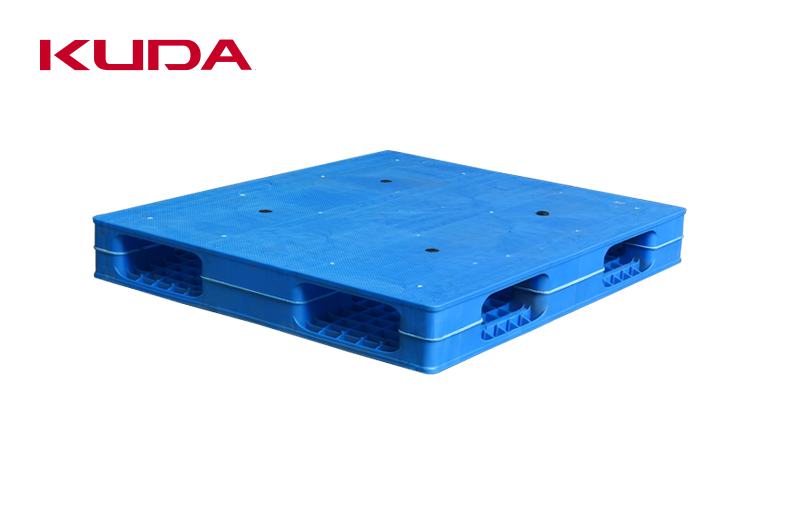
Application of flat plastic pallets in the logistics industr
Source: kuda 2026-01-12
Flat plastic pallets are indispensable infrastructure in the modern logistics system. Made from high-strength plastic materials through injection molding or blow molding processes, they feature a flat load-bearing surface design. Their core value is reflected in three dimensions: standardization, durability, and versatility. As an internationally accepted unit for cargo consolidation, they enable standardized handling throughout the entire process from production to consumption, significantly enhancing supply chain efficiency. Compared to traditional wooden pallets, plastic materials impart waterproof, moisture-proof, corrosion-resistant, and easy-to-clean characteristics, with a service life of up to 5-8 years and a reduction in overall cost of more than 30%. In industries such as food and medicine, where hygiene requirements are strict, their non-porous surface design prevents bacterial growth, making them the preferred carrier for safe transportation.
From manufacturing workshops to global ports, flat plastic pallets have built a seamless logistics network. In the automotive industry, they facilitate the precise flow of precision components on the assembly line. In cold chain logistics, their low-temperature resistance ensures the stable transportation of fresh produce in an environment as cold as -25℃. In the field of cross-border e-commerce, standardized sizes (such as 1200×1000mm) perfectly fit container space, reducing shipping losses. According to statistics, the global plastic pallet market is growing at an annual rate of 8.2%, with the Asia-Pacific region accounting for over 40% of the market share, and China, as a manufacturing hub, contributing 65% of the production capacity. This penetration stems from its modular design - it can be nested and stacked, saving 75% of storage space, and its forklift holes are compatible with various loading and unloading equipment.
Breakthroughs in materials science are reshaping the plastic pallet industry. The new copolymer polypropylene (PP) material reduces the self-weight of pallets by 20% while increasing their load-bearing capacity to 2 tons dynamically and 6 tons statically. Smart pallets, embedded with RFID chips, enable tracking of goods throughout their entire lifecycle, resulting in a 15% reduction in inventory errors for Wal Mart's supply chain. In terms of environmental protection, bio-based plastic pallets (containing 30% plant fiber) have entered mass production, reducing their carbon footprint by 40% compared to traditional products. The rise of circular economy models, such as the pallet sharing system established by Germany's Logistik Group, has achieved an annual turnover of 12 times for a single pallet, increasing resource utilization by 300%.
Facing the global carbon neutrality goal, the industry is undergoing a dual transformation: on the one hand, developing degradable trays (such as PLA materials), and on the other hand, reducing raw material usage by 30% through structural optimization. The application of digital twin technology has shortened the tray design cycle by 60%, and 3D printing technology has given birth to customized irregular trays. However, challenges still exist - cost pressures due to fluctuations in raw material prices, and new EU regulations requiring all plastic trays to contain 25% recycled materials by 2027. Leading companies such as ORBIS have formed a closed loop from raw material modification to recycling through vertical integration of the industrial chain, keeping the cost of recycled materials within 85% of that of virgin materials, providing a model for sustainable development in the industry.


 2026-01-12