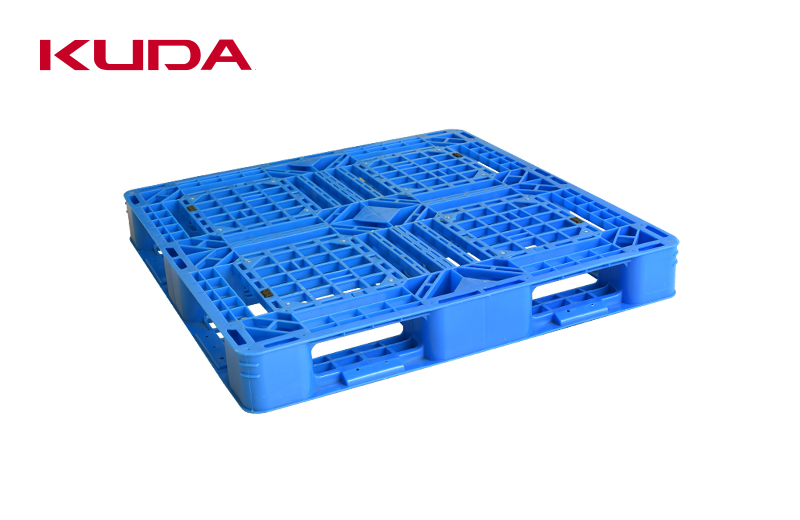
Reusable plastic pallets are emerging as a revolutionary force in modern logistics, reshaping cargo transportation with their durability and standardized design. Compared to disposable wooden pallets, plastic pallets are injection molded from high-density polyethylene (HDPE) or polypropylene (PP), boasting impact resistance and corrosion resistance. With a service life of up to 5-10 years, they significantly reduce long-term costs. Their lightweight design (with a self-weight only one-third of that of wooden pallets) reduces transportation energy consumption, while standardized dimensions (such as the European standard of 1200×1000mm) enhance compatibility with automated equipment, laying the foundation for efficient warehousing and cross-border logistics. These pallets are not just load-bearing tools, but also key nodes driving supply chain efficiency.
The core advantage of reusable plastic pallets lies in the balance between cost, efficiency, and sustainability. The optimization of total lifecycle costs results in a high initial investment, but the long-term usage cost is only one-third of that of wooden pallets. The compatibility with automation, such as a tolerance design of ±2mm, ensures seamless integration with AGVs and stackers, thereby enhancing operational efficiency. In terms of application scenarios, it covers manufacturing, cold chain, and cross-border logistics: electronic component pallets protect precision components through anti-static design, while cold chain pallets maintain flexibility at -30℃ to avoid food loss. The fumigation-free feature simplifies cross-border procedures, saving 15-20% of logistics costs. These features make them a powerful tool for cost reduction and efficiency improvement across multiple industries.
With the development of the Internet of Things, smart plastic pallets are leading the industry transformation. RFID integration enables full traceability of goods, reducing the rate of damage; sensors embedded in the pallets monitor temperature and humidity, providing real-time data support for the cold chain. In terms of environmental protection, plastic pallets are 100% recyclable, reducing deforestation, and each ton of recycled pallets is equivalent to a reduction of 3 tons of CO₂ emissions. Innovative materials such as bio-based plastics further reduce carbon emissions and promote green logistics. This dual evolution of intelligence and environmental protection has transformed pallets from static tools into dynamic data nodes, helping enterprises achieve sustainable development goals.
In the future, reusable plastic pallets will deeply integrate new materials and technologies, such as biobased plastics, to reduce carbon emissions by 50%. When selecting pallets, enterprises should consider the specific scenarios: steel-cored embedded pallets are preferred for heavy-duty transportation, blue HDPE pallets are suitable for food and pharmaceuticals, and anti-static design is ideal for electronic products. In terms of maintenance, regular cleaning and stacking restrictions (dynamic 3 layers, static 5 layers) can extend their lifespan. Through scientific selection and meticulous management, plastic pallets will continuously unleash logistics efficiency, becoming the core driving force of intelligent and green supply chains, leading the industry towards a new era of efficiency and environmental protection.Development trend of turnover plastic pallets


 2026-01-09