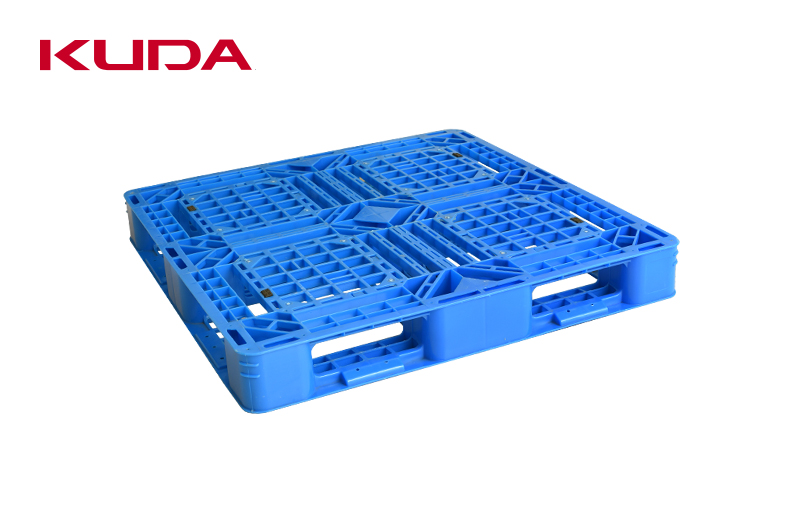
Application of standard dimensions for plastic pallets
Source: kuda 2026-01-22
The standard dimensions of plastic pallets vary by region, with different specifications established by the International Organization for Standardization (ISO) and regional bodies. ISO recommends universal sizes such as 1200×800mm and 1200×1000mm, aiming to reduce logistics confusion and enhance global supply chain efficiency. The European Committee for Standardization (CEN) has defined European standard pallets, such as 1200×800mm (widely used in Germany and France) and 1200×1000mm (commonly found in the United Kingdom and the Netherlands). These dimensions ensure compatibility in cross-border transportation and reduce conversion costs. In contrast, the United States tends to prefer 1200×1000mm (American standard), while Asian countries such as Japan commonly use 1100×1100mm, highlighting the diversity of regional logistics needs.
The Chinese plastic pallet standard is based on GB/T 15234-1994, with priority given to two sizes: 1200×1000mm and 1100×1100mm. The former is widely recommended due to its compatibility with most racks and forklifts. This choice stems from domestic logistics research, aiming to balance efficiency and cost, and avoid resource waste caused by non-standard sizes. Despite the existence of other commonly used specifications (such as 1200×1200mm), the national standard emphasizes uniformity to promote warehouse automation and reduce transportation losses.
In practical applications, standard sizes may not satisfy all scenarios, thus giving rise to customized pallets. For instance, the automotive parts industry may require special sizes to match heavy equipment, while the food and pharmaceutical sectors prefer hygienically designed grid pallets. Although customization increases costs, it optimizes space utilization and operational safety. Furthermore, the combination of styles (such as Chuan-shaped and Tian-shaped) with sizes further adapts to different loads and handling methods, reflecting the flexibility of logistics equipment.
Standardization of pallet dimensions has profound economic implications. As the Australian case demonstrates, changes in dimensions can lead to significant gains or losses, highlighting the importance of stable standards. Future trends are focused on international coordination. Although ISO continues to expand its specifications to accommodate diversity, core dimensions (such as 1200×1000mm) remain mainstream. China is promoting alignment with international standards, reducing cross-border logistics costs through unified dimensions, while encouraging innovative designs to meet the needs of emerging industries.


 2026-01-22