In the field of logistics and warehousing, forklift pallets serve as the core carriers for cargo handling, and their design and functionality directly impact operational efficiency and cost control. Due to their lightweight, corrosion resistance, environmental friendliness, and recyclability, plastic pallets are gradually replacing traditional wooden pallets and becoming the preferred choice in modern logistics systems. This article will focus on the different structural types of plastic pallets and their functional advantages, exploring ways to enhance logistics efficiency through structural optimization.
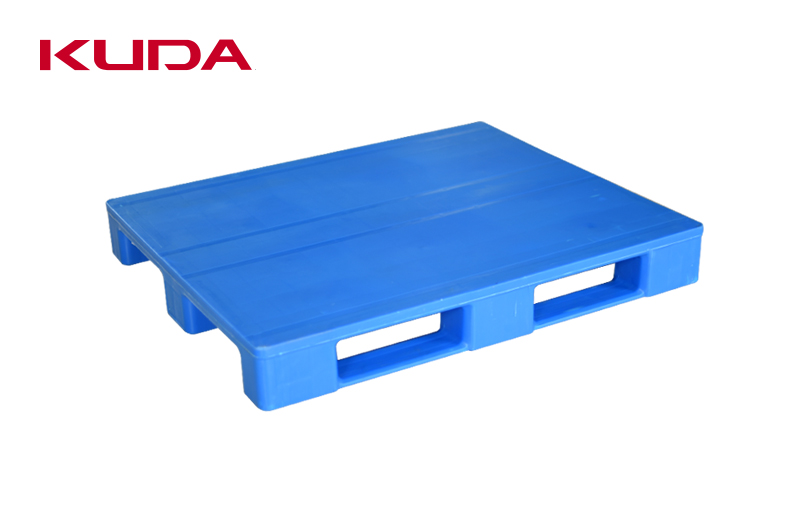
The structural design of plastic pallets is the foundation for achieving their functions. Common types include the Chuan-shaped, Tian-shaped, nine-foot, and double-sided pallets. The Chuan-shaped pallet features a "Chuan" pattern of three parallel beams at the bottom, which endows it with excellent stability, evenly distributes the pressure of goods, and effectively prevents deformation, making it particularly suitable for stacking heavy objects. The Tian-shaped pallet forms a "Tian" grid with four crisscrossed beams, providing stronger load-bearing capacity and suitable for multi-layer stacking of hard-packed goods. However, it is important to note that soft-packed goods may block the insertion holes. The nine-foot pallet has a simple structure and low cost. Its four-way forklift design makes it extremely flexible for manual hydraulic vehicle operations, suitable for small warehouses or goods with frequent turnover. The double-sided pallet is divided into flat and grid types, both of which support four-way forklift insertion and are suitable for mechanical forklift operations. It allows for dual-sided use, enhancing space utilization. These structural differences directly determine the applicability of pallets in different warehousing environments.
The functional design of plastic pallets is closely centered around logistics efficiency, with core features including shelf-loadable, stackable, nestable, and four-way forklift-accessible. The shelf-loadable function requires precise matching between the pallet and shelf dimensions to avoid operational difficulties caused by being too wide or too narrow, while also considering the impact of shelf type on load capacity, such as the differences between beam racks and push-back racks. Stackability is achieved through a tianzi (Chinese character meaning "field") or double-sided structure, ensuring stable engagement at the bottom when stacked multiple layers, reducing the risk of cargo collapse. The nestable design allows for efficient stacking and recycling of empty pallets, saving storage space, with nine-foot pallets being particularly prominent due to their sloped bottom cavities. The four-way forklift-accessible function is a revolutionary improvement in logistics efficiency, allowing forklifts to operate from any direction, reducing the demand for aisle space and significantly improving the utilization rate of storage area in large e-commerce warehouses. These functions work together to make pallets the "hexagonal warriors" of logistics operations.
Plastic pallets have a wide range of application scenarios, from traditional warehousing to intelligent logistics systems, with their structure and functional design continuously evolving to meet demands. In large e-commerce warehouses, four-way forklift-accessible pallets reduce aisle space through flexible operations, enhancing storage efficiency. In cold chain logistics, HDPE pallets are resistant to low temperatures, ensuring the safety of goods. With the development of Internet of Things technology, pallets are moving towards intelligence, such as integrating sensors to enable cargo tracking and further optimize logistics management. In the future, customized pallets will meet the needs of specific industries, such as hygiene standards in the pharmaceutical or food industries. From basic handling to intelligent integration, plastic pallets continue to drive the logistics industry towards efficiency and environmental protection.


 2026-01-20