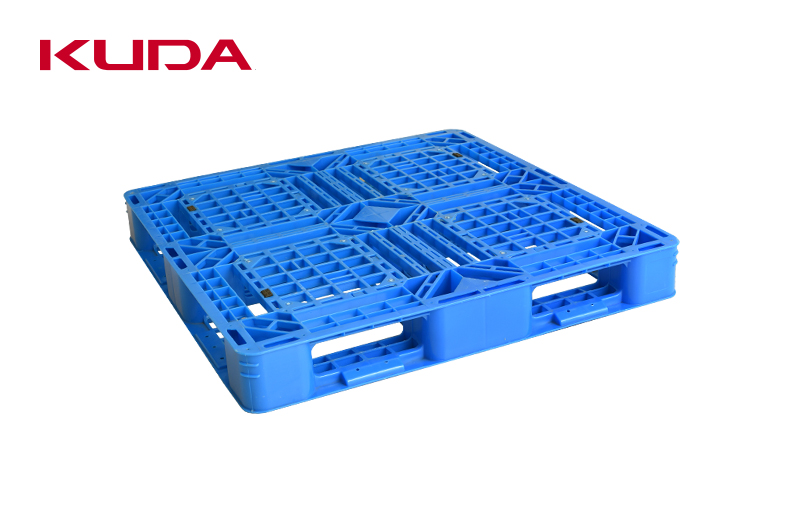
The difference between the Tianzi and Chuanzi pallet
Source: kuda 2025-12-16
In the field of warehousing and logistics, plastic pallets serve as the core carrier for storing and transporting goods, and their structural design directly affects operational efficiency and safety. As two mainstream types, Tianzi tray and Chuanzi tray exhibit significant differences in load-bearing capacity, stability, and applicable scenarios due to their unique bottom structure. This article will deeply analyze the differences between the two from four dimensions: structural characteristics, performance, equipment adaptation, and scenario application, providing decision-making basis for warehouse optimization.
The bottom of the Tian shaped tray is crisscrossed by four horizontal beams, forming a regular "Tian" shaped structure with dense and evenly distributed support points. This design enhances the rigidity of the pallet, making the force more dispersed and significantly improving its bending resistance, especially suitable for stacking heavy goods. In contrast, the bottom of the Sichuan style tray only has three parallel horizontal beams, distributed in a "Sichuan" shape, with a simple and lightweight structure and better ventilation. However, it has fewer support points and requires higher local load-bearing capacity. The dense support of the Tianzi tray makes it less prone to deformation during long-term use, while the Chuanzi tray compensates for structural deficiencies and optimizes shelf adaptability by incorporating steel pipes or modified materials (such as fiberglass reinforcement).
In terms of carrying capacity, the Tianzi tray has a dense bottom support, outstanding static and dynamic load performance, and is suitable for storing heavy goods. It has excellent stability when stacked and can effectively reduce the risk of cargo damage. Chuanzi pallets are known for their flexibility and ventilation, and their dynamic load capacity can be improved to a higher level through reinforced design (such as built-in steel pipes).
However, their static load is relatively weak, making them suitable for the turnover of medium and light goods. In terms of stability, the Tianzi tray is not easily overturned due to its wide load-bearing area, while the Chuanzi tray may have slightly lower stability during short distance loading and unloading due to scattered support points. In addition, the four-way fork design of the Tianzi pallet is suitable for various forklift operations, while the two-way or four-way fork capability of the Chuanzi pallet makes it more efficient in automated warehousing.
The multi-directional fork design of the Tianzi pallet makes it highly compatible with various forklift equipment, especially suitable for manual or electric forklift operations in traditional storage environments. Its bottom structure can precisely fit with the shelf crossbeam, reducing the risk of jamming and performing well in scenarios such as drive in shelves. Chuanzi tray is specifically optimized for shelf storage, with a large contact area between the bottom crossbeam and the shelf, and uniform force distribution. It is the "golden partner" of crossbeam shelves, which can significantly improve space utilization. For example, in e-commerce warehouses, Sichuan style pallets can reduce incidents of goods falling off and are compatible with stacker cranes in automated warehouses for efficient storage and retrieval.
Due to its high load-bearing capacity and stability, Tianzi pallets are widely used for stacking heavy goods, such as raw material storage in manufacturing or distribution of large goods. They can withstand long-term pressure without deformation. The Sichuan style tray is more suitable for scenarios that require high hygiene and ventilation, such as food and pharmaceutical cold chain logistics. Its seamless top design meets hygiene standards, can withstand disinfection treatment, and the ventilation structure prevents the goods from moldy. In cold chain environments, Sichuan style pallets have excellent moisture resistance and can reduce cargo damage, while Tianzi style pallets win with cost-effectiveness and durability in ordinary storage. When selecting, it is necessary to consider the characteristics of the goods, storage period, and environmental conditions to achieve optimal warehousing efficiency.


 2025-12-16